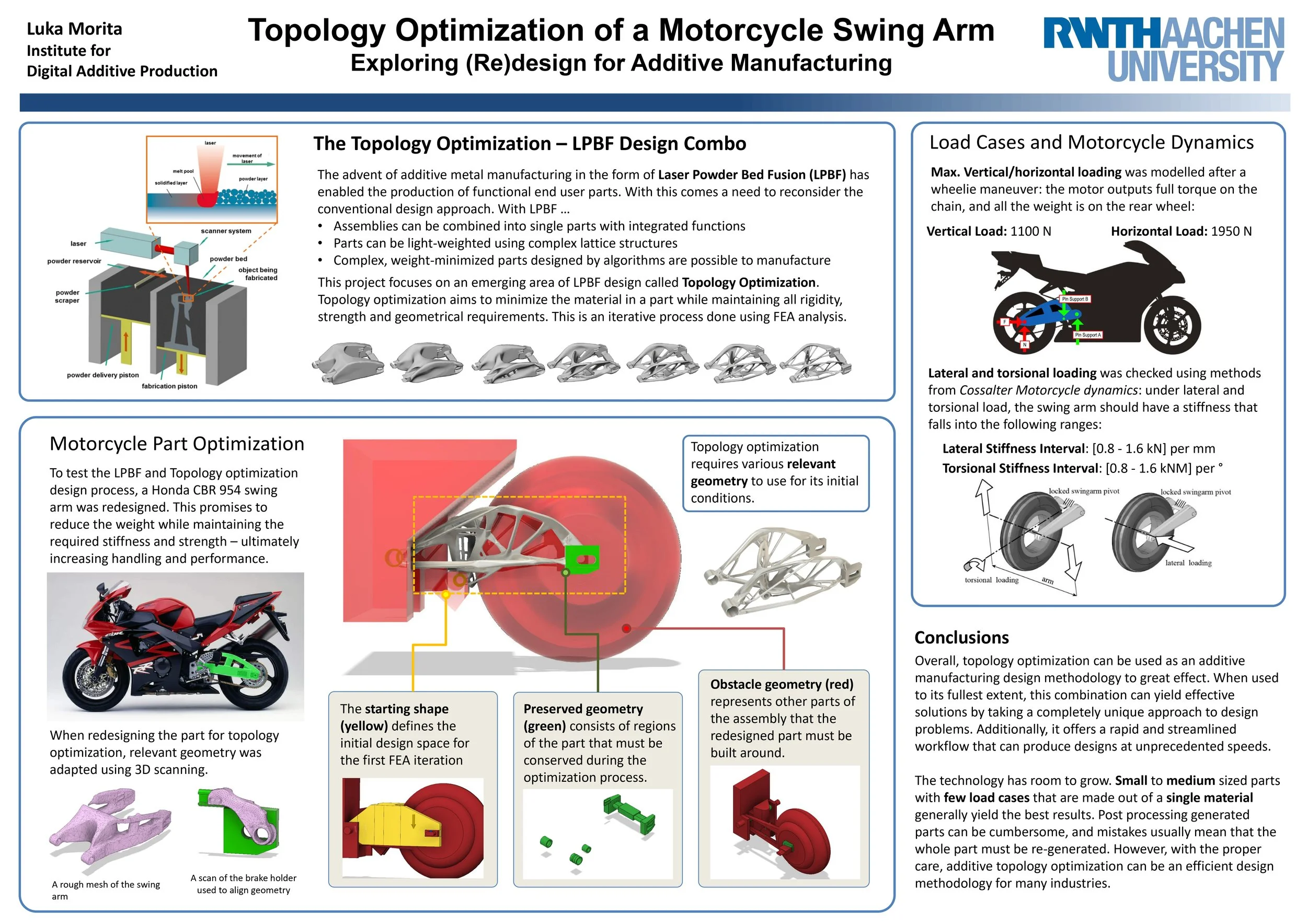
Topology optimization of a Motorcycle Swingarm
For my first co-op internship, I had the opportunity to travel to Aachen, Germany and conduct a research project at RWTH University’s Digital Additive Production (DAP) Institute. During this project, I physically dismantled a Honda CBR 954, then 3D scanned and reverse engineered the motorcycle’s swingarm. I then performed topology optimization to generatively redesign a version of the swingarm that was 22% lighter while maintaining the same strength under key loading conditions. The complex, organic design would be almost impossible to manufacture with traditional technology; however, with the use of laser powder bed fusion (LPBF) metal additive manufacturing, we successfully demonstrated printing of a real-life scale model of this part.